Troubleshooting
Fixing Rust on a Truck Bed: Surface Rust, Holes and Prevention
Surface rust on a steel truck bed is a weekend job: wash, wire-brush off the loose rust, apply a rust converter, let it cure and paint over it. Rust that has eaten a hole through the floor or sits at the bed mounts is body shop work. Either way, find where the water comes from, or the rust comes back.
The short version
For surface rust, wash the bed, let it dry, remove loose rust and paint with a wire brush or sandpaper, then apply a rust converter such as Rust-Oleum's Rust Reformer and topcoat after it cures. Holes, flaking that goes deep, or rust at the bed mounts need a body shop. Check your corrosion warranty first: Ford covers perforation for five years, unlimited miles.
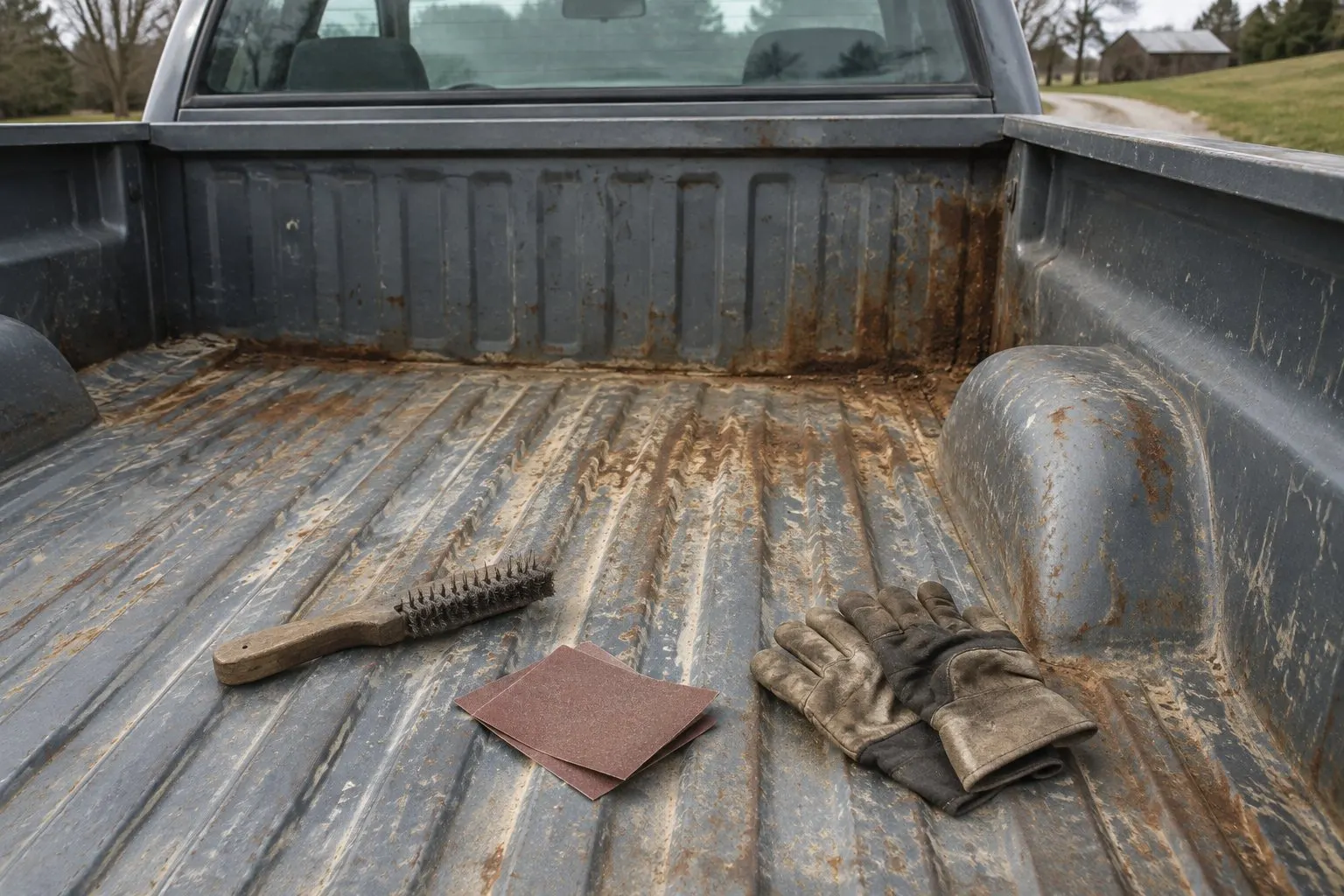
Surface rust or a hole?
Push on the rusty spot with a screwdriver handle. That tells you which job you have.
| What you find | What it is | Who fixes it |
|---|---|---|
| Orange dust or freckles on the paint | Surface rust | You, this weekend |
| Paint bubbling with rust under it | Rust spreading under the paint | You, if the metal is solid once brushed |
| Flakes or scale that keeps coming off | Deep rust | Look again after brushing; often a body shop |
| The screwdriver goes through, or you see daylight | Perforation | Body shop, or check the warranty |
| Rust at the bed mounting points or the frame under the bed | Structural | Body shop or dealer, not a paint job |
Before you spend money on a hole, check the warranty. Ford's spec sheets list corrosion coverage for perforation at five years with unlimited miles on the F-150, Ranger and Super Duty, with the F-150 and Ranger lines excluding aluminum. Your own warranty booklet has the details for your truck. The truck bed guide explains the parts named here.
Steel, aluminum or composite?
Not every bed can rust the way an old steel bed does. Ford builds the F-150 body from aluminum alloy, and the 2025 Super Duty has an aluminum bed and cab. Toyota's 2024 Tacoma bed is made of sheet-molded compound, a composite. Aluminum does not form red, flaking rust, but it can still corrode. Rust converters are made for rusty steel, and the Rust Reformer data sheet says not to use it on galvanized metal. For marks on an aluminum or composite bed, ask the dealer before you treat them.
Fixing surface rust, step by step
These steps follow Rust-Oleum's technical data sheet for its Automotive Rust Reformer spray, a converter that bonds with rust and turns it into a flat black, paintable surface, so you do not have to sand to bare metal. Other converters have their own sheets. Read yours.
Pick the right day
Work outdoors or in an open garage, between 50 and 90°F and below 85 % humidity, so it dries properly. Avoid wind and dust.Wash and dry
Clean the area with soap and water, rinse and let it dry completely. Lift any mat or drop-in liner first.Brush off the loose stuff
Remove loose paint and rust with a wire brush or sandpaper. Lightly sand glossy paint around the spot so the coating grips. On older trucks, mind the lead warning: scraping or sanding old paint can release lead dust, so wear a NIOSH-approved respirator.Mask off
Cover the bed rails, tailgate seal and anything you do not want black, including the seals of a tonneau cover.Spray two light coats
Shake the can for a full minute after the mixing ball rattles. Hold it 10 to 16 in from the surface and spray in steady, overlapping strokes. Two light coats a few minutes apart look better than one heavy one.Let it cure, then topcoat
The sheet gives 24 hours to dry before a topcoat, and longer in cooler weather. Then paint over it or add the bed liner coating of your choice.
Where the water comes from
Rust needs water that stays. In a truck bed it usually comes from one of these:
- Under mats and drop-in liners. Water gets in and dries slowly. Lift them after heavy rain or a car wash.
- Clogged drains. Ford's maintenance schedule asks you to check body and door drain holes for obstructions every six months and to flush the underside of the truck often.
- Scratches through the paint. Tools, gravel and loose cargo cut through the finish. Ford's manual says to touch up exposed or primed metal to prevent rust.
- A cover that lets water in. RealTruck says no tonneau cover seals completely and that slight seepage may occur from high-pressure water. A little seepage after a pressure wash is normal; standing water after every rain is not.
- Road salt. It gets thrown into the bed and the wheel wells. Rinse it out in winter.
Keeping it dry under a roll-up cover
A roll-up cover keeps rain and snow off most of the bed, which helps. But a cover that pools or drips puts water exactly where it can sit for days. If you find wet corners under yours, work through the leak fixes: crossbars arched upward, tension, the front seal and the tailgate seal. Hard covers like Rough Country's run drain tubes into the front of the bed wall, so make sure those are clear and not kinked.
To see what a well-sealed cover can and cannot do, read do roll-up covers leak. For how liners sit under a cover, see bed liners and tonneau covers. And if the tailgate area is rusty because the tailgate never closed tight, the tailgate latch fixes may be the real cure.
When to stop and call a shop
- You can see daylight through the floor or a wall.
- The rust is at the bed mounting bolts, the crossmembers under the bed or the frame.
- The metal is soft after brushing, or the brushed area keeps growing.
- The truck is still inside its corrosion warranty.
A shop can patch or replace panels, or swap the bed. Paint over structural rust only hides it.
What owners ask
Can a rusted truck bed be fixed?
Surface rust, yes, with cleaning, a rust converter and paint. A floor with holes can be patched by a body shop, or the bed can be replaced. Before you pay, check whether the truck is still inside its corrosion warranty, which covers perforation on many trucks.
Do truck bed mats cause rust?
A mat does not rust anything by itself, but water that gets under it has nowhere to go and dries slowly. If your bed takes on water, lift the mat after rain or washing and let the floor dry. Ford's manual asks owners to keep body drain holes free of packed dirt.
Do aluminum truck beds rust?
Not in the red, flaking way steel does. Ford builds the F-150 body from aluminum alloy and the Super Duty with an aluminum bed and cab, and Toyota's 2024 Tacoma bed is a composite. Aluminum can still corrode. Ford's corrosion warranty line for the F-150 excludes aluminum, so ask the dealer about anything you see.
Does a bed liner prevent rust?
It protects paint from scratches, which is where rust usually starts on a steel bed. But water that gets behind a drop-in liner can sit there. Whatever liner you have, check under or around it now and then. See our bed liner page for how liners and covers work together.
Sources
- Rust-Oleum: Automotive Rust Reformer spray, technical data (Home Depot-hosted PDF)
- Ford: 2014 F-150 owner's manual, Vehicle Care and Scheduled Maintenance (PDF)
- Ford: 2026 F-150 specifications (PDF)
- Ford: 2025 Super Duty technical specifications (PDF)
- Toyota: All-new 2024 Tacoma press release
- RealTruck: What is the best roll-up tonneau cover?
- Rough Country hard roll-up installation manual (SEMA Data)
Where to next
- TroubleshootingLeak fixesWater under your roll-up cover? Check crossbars, tension, front seal and tailgate seal, in that order. Fixes come from Tyger, Gator and Rough Country documents.
- OverviewTruck bed guideA plain guide to the truck bed: what each part is called, real inside sizes from Ford and Toyota, and how to protect, load and sleep in it with a cover on.
- ExplainerBed linersSpray-in, drop-in, mat or roll-on paint: how each truck bed liner handles grip, water and wear, and which one lets a roll-up cover clamp without cutting.
- Question & answerDo Roll-Up Tonneau Covers Leak?Yes, some water can get past any roll-up tonneau cover. What RealTruck states, what Tyger's sheets blame for pooling, and how to keep cargo dry that has to stay dry.
- TroubleshootingTailgate latch repairTailgate won't latch, won't open or drops open? Check recalls first, then latches, rods, strikers and cables. When to replace the truck tailgate.
Who is behind this
rolluptonneaucover.com Editorial Team
Truck fit and buying advice
We are the editorial team at rolluptonneaucover.com. We read listing titles, maker install sheets and truck makers' own bed specifications and sort them truck by truck, with sources on every page. Nobody here has bolted these covers to a truck, and nothing was measured in a lab. We say so plainly.
- Listing titles and maker sheets read
- Sources on every page
- No installs and no lab work
- Publisher details in the imprint