How-to
Kayak in a Truck Bed With the Tailgate Up: How to Load and Strap It
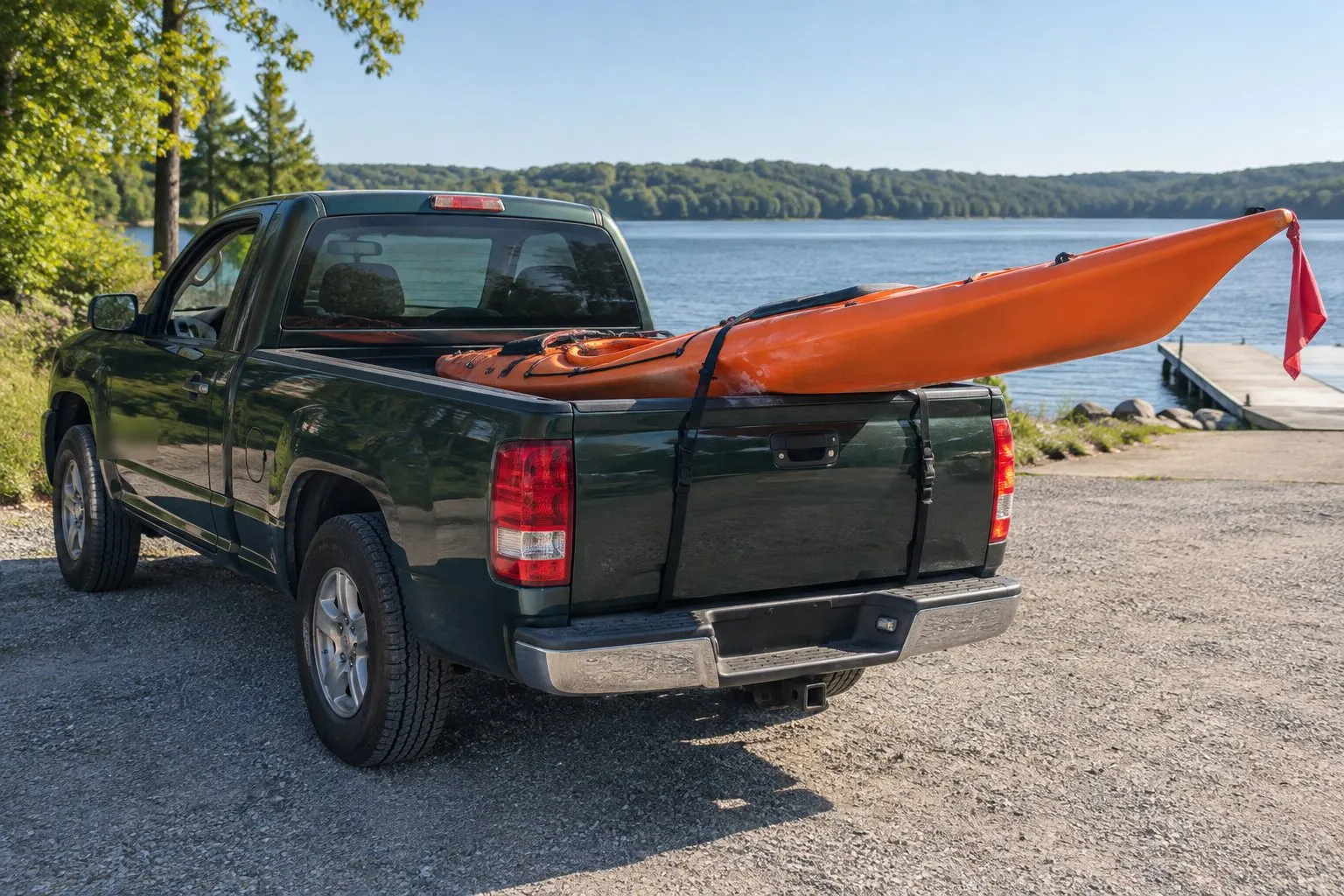
Yes, you can carry a kayak in a short truck bed with the tailgate up. Slide it in bow first, rest the bow on the floor against the front wall and the hull on the top of the closed tailgate, then strap the bow and the stern to the bed's floor anchors. A 10 ft kayak in a 5.5 ft F-150 box sticks out roughly 4 ft, which is where flag rules start.
The short version
Load the kayak bow first, bow down at the front wall and the hull resting on the closed tailgate. Run a cam strap from a floor anchor through the bow handle and another from the stern handle to anchors on both sides, in a V. Flag the end if it sticks out more than 4 ft. With a roll-up cover, roll it all the way to the cab and strap it.
Before you start
You need two cam straps, a red or orange flag, and a truck bed with anchor points on the floor or the bed rails. A short bed is fine for many recreational kayaks. Longer touring boats and paddleboards work the same way but stick out further, so read the overhang table first. For a quick tour of what is where in the bed, see the truck bed guide.
Load and strap it
Open up the bed
Roll a roll-up cover all the way to the cab and fasten both straps. Clear loose items off the floor.Slide it in bow first
Lift the stern, slide the kayak in bow first and let the bow settle on the floor against the front wall. The hull rests on the top edge of the closed tailgate.Strap the bow
Run a cam strap from a floor anchor through the bow handle or hardware, so the boat cannot slide back out.Strap the stern in a V
Run a strap from an anchor on one side, through the stern handle, to an anchor on the other side. The V stops the stern swinging left and right.Flag the overhang
More than 4 ft past the rear? Tie a red or orange flag to the very end. At night, add lights where your state asks for them.Check after a few miles
Stop after a few miles. Straps settle, and a kayak that moved an inch in town can move a foot on the highway.
LINE-X suggests cam straps rather than ratchet straps, because ratchets can press too hard on the hull. A folded towel where the hull sits on the tailgate protects both the boat and the paint.
How far will it stick out?
We worked this out from Ford's F-150 box sizes: 67.1, 78.9 and 97.6 in along the floor, and 21.4 in inside height. With the bow on the floor at the front wall and the hull resting on the top of the closed tailgate, the kayak sits at an angle, and the rest of it hangs out the back. These are rough estimates, measured flat behind the tailgate. A thick hull, a raised bow or a bed liner will change them by a few inches, so measure your own setup.
| Kayak length | 5.5 ft box | 6.5 ft box | 8 ft box |
|---|---|---|---|
| 8 ft | about 2 ft | about 1 ft | fits inside |
| 10 ft | about 4 ft | about 3 ft | about 1.5 ft |
| 12 ft | about 6 ft | about 5 ft | about 3.5 ft |
| 14 ft | about 7.5 ft | about 7 ft | about 5.5 ft |
So the common 10 ft recreational kayak in a short box lands right at the 4 ft line. Flag it anyway. For other trucks, put your bed length from the bed length chart into the same idea: the longer the bed, the flatter and shorter the overhang.
Flags, lights and the law
Rules for loads that stick out are set by each state. Washington's code is a clear example. A load more than 4 ft past the rear needs red or orange fluorescent warning flags at least 18 inches square at its ends. When a load sticks out 4 ft or more, two red lamps visible from 500 ft to the rear are required at night. The federal rule in 49 CFR 393.87 uses the same 4 ft line and 18 inch flags, but it is written for commercial vehicles. Check your own state's vehicle code or driver handbook before a long trip.
Your roll-up cover and the kayak
A roll-up cover has one big advantage here: it rolls up to the cab and stays on the truck. Gator's sheet sets the rules for doing that safely:
- Tall cargo means the cover is fully rolled open and fastened with both retainer straps.
- Never drive with the cover partly open, so do not try to roll it over the kayak halfway.
- Cargo must not contact the tarp. Keep the bow on the floor, below the rolled cover, and not leaning on it.
- Do not roll the cover into the rear cab window or stow it against the cab.
More on this in can you drive with a roll-up cover open.
Tailgate up or down?
| Tailgate up | Tailgate down | |
|---|---|---|
| Support under the hull | One edge, at an angle | Longer, flatter support |
| Overhang past the tailgate | More, angled up | Less past the tailgate end |
| Best for | Short kayaks, short trips | Longer kayaks, LINE-X's first choice |
| Watch out for | Hull pressure at the tailgate edge | Tailgate load limit in your manual |
LINE-X notes that most kayaks will not fit in the bed with the tailgate up. If yours is long, or you carry two, a bed extender or a rack is the more comfortable answer. Carrying bikes on the same trip? See how to haul a bike in a truck bed.
What owners ask
Which direction should a kayak go in a truck bed?
Bow first, toward the cab, so the stern sticks out over the tailgate. LINE-X's guide slides the kayak in bow first and straps it at both ends. Whichever end goes in first, the end that overhangs is the one that needs the flag.
Is it legal to have a kayak sticking out of a truck bed?
Yes, within your state's rules. Washington, for example, requires red or orange fluorescent flags at least 18 inches square on any load more than 4 ft past the rear, and two red lamps at night once a load sticks out 4 ft or more. Check your own state's vehicle code.
Should I use ratchet straps on a kayak?
LINE-X advises against them, because they can put too much pressure on the hull. Cam straps are easier to set by hand. If you do use ratchets, tighten only until the boat stops moving.
Is the tailgate up or down better for a kayak?
Down gives more support under the hull, and LINE-X calls it the best way for most kayaks. Up keeps the boat at an angle with less resting on the tailgate, which suits shorter kayaks in short beds. Either way, strap both ends.
Sources
Where to next
- Question & answerCan You Drive With a Roll-Up Cover Open?Yes, if the cover is fully rolled and strapped. Gator's sheet says never partly open, and warns against stowing it against the cab. What else its rules cover.
- OverviewTruck bed guideA plain guide to the truck bed: what each part is called, real inside sizes from Ford and Toyota, and how to protect, load and sleep in it with a cover on.
- ExplainerBed extendersA truck bed extender turns the lowered tailgate into usable bed length. How flip-over and hitch-mounted types differ, what the install asks, and the cover rules.
- How-toMeasure your bedMeasure your truck bed in one minute, then check it against our bed length chart for Tacoma, F-150, Tundra, Ranger, Frontier, Ridgeline and more.
- How-toBikes in the bedThree ways to carry bikes in a pickup: a tailgate pad, an in-bed mount or laying them flat. What the pad makers' sheets ask, and what to do with a roll-up cover.
Who is behind this
rolluptonneaucover.com Editorial Team
Truck fit and buying advice
We are the editorial team at rolluptonneaucover.com. We read listing titles, maker install sheets and truck makers' own bed specifications and sort them truck by truck, with sources on every page. Nobody here has bolted these covers to a truck, and nothing was measured in a lab. We say so plainly.
- Listing titles and maker sheets read
- Sources on every page
- No installs and no lab work
- Publisher details in the imprint